“The works here offer a glimpse into my experimentation and processes of working with forms that expand upon the uses of traditional kapa (barkcloth) as a primary medium. From suspended installation, to large-scale wall-based ‘quilts,’ wearable objects, and mixed-media approaches, these pieces push the boundaries of this ancestral material while acknowledging its deep cultural history and significance. These visual forms and installation methods, innovative and contemporary in nature, are not things you’d see my ancestors doing hundreds of years ago. Nevertheless, the roots of these textiles and organic media continue to resonate through my intentional materiality, use of customary motifs, and emphasis on elevating craft as fine art.”
Kiliwehi, 2026
Part of a new body of work honoring cycles of creation, birth, destruction, and rebirth as seen through a Native Hawaiian cosmological framework, this large-scale quilted work uses natural dyes to mirror the colors of an active volcanic eruption — the golden tones of molten magma, the smoldering reds of cooling lava, and the deep blue-blacks of newly-formed rock. In the Native Hawaiian worldview, the volcanic activity of Pelehonuamea (a feminine deity associated with fire and the creation of new land) is seen as an elemental force of creation and destruction simultaneously. Likening this cosmology to the transformation in becoming a mother, this work situates the artist in a continuity of creation — cultural, genealogical, and profoundly universal.
Kiliwehi (detail)
Kiliwehi. Kapa, natural plant dyes, wildfire charcoal, ochre pigment, metal leaf, thread. 101 inches H x 118 inches W. 2026. Private collection.
Still Finding My Way Back Home (detail)
Still Finding My Way Back Home, 2025
This installation is part of a larger body of mixed-textile works that seek to empower my community through the celebration of the cultural intersections that we collectively embody. Like so many who call Hawaiʻi home today, I was raised within my Native Hawaiian and Japanese heritages, growing up learning both languages and taking part in practices unique to each community. Despite so much cultural overlap in the roots of my upbringing, there are many complex intersectional histories that were often overlooked or understated, including racial conflict, economic disparity, displacement, and social assimilation. This piece seeks to address these long-spanning themes by incorporating textile traditions and narrative patterns specific to both my Native Hawaiian ancestors and my Japanese ancestors who left their country to work on plantations. By individually hand-stitching each textile fragment together, this ‘quilt’ intentionally mirrors the many generations of intricate, interwoven cultural relationships unique to Hawaiʻi and its people. The traditional textiles used throughout our lives, such as kapa and silk, are inherently reflective of place, time, and connection, and by combining them in a manner that honors their uniqueness yet blurs the line between them, I aim to represent these narratives through a quilt greater than the sum of its parts.
Still Finding My Way Back Home. Kapa, reclaimed Japanese fabrics, vintage rice bags, indigo and madder root dyes, ceramic beads, bells, earth pigments, hand-embroidery. Approx. 9 feet H x 17 feet W. 2025. Collection of the Crystal Bridges Museum of American Art.
Still Finding My Way Back Home (detail)
Still Finding My Way Back Home (detail)
Hoʻoulu Pū (Growing Together) [installation view]. Dyed kapa (barkcloth) tapestries and hand-stitched appliqué. 15 feet H x 10 feet W. 2024. Commissioned by the Oregon Arts Commission.
Hoʻoulu Pū (Growing Together), 2024
These tapestries, made from hand-stitched and beaten traditional Hawaiian barkcloth (kapa), speak to the ongoing histories of connection and exchange between Native Hawaiians and Indigenous communities in the Pacific Northwest, dating back to at least 1787. With Hawaiian quilt patterns representing plants from both Oregon and Hawaiʻi that carry deep cultural and ecological significance, these stories of relationship-building are told through the flora we grow alongside. In doing so, this piece also works to honor the original stewards of the land on which Portland State University is now located, including the Multnomah, Siletz, Wasco, Molalla, Kathlamet, Kalapuya, Atfalati, Chinook, and Cowlitz, among others.
Hoʻoulu Pū (Growing Together) [installation view]
Hoʻoulu Pū (Growing Together) (detail)
Hoʻoulu Pū (Growing Together) [installation view]
Mele O Nā Kaukani Wai (Song of a Thousand Waters), 2018
Mele O Nā Kaukani Wai (detail)
Mele O Nā Kaukani Wai (Song of a Thousand Waters) addresses the need for an integration of Indigenous Traditional Ecological Knowledge (TEK) and contemporary Western science as we work to find solutions to ongoing climate change and environmental degradation. To approach these complex and multifaceted subjects, Lehuauakea uses the metaphor of the muliwai — where the river meets the sea, where saltwater and fresh water intertwine. The artist also employs Native Hawaiian dye and ochre paint techniques and traditional ʻohe kāpala patterns and motifs, alongside commercially available gouache, again alluding to the need for a weaving of different approaches to achieve a shared vision. As Native Hawaiians, like many Indigenous peoples of the Pacific, face firsthand the violent sociopolitical effects of global ecological decline, it is critical to look to Native ways of relating to each other, the lands and waters, and ourselves so that we may find better modes of moving into an uncertain future. Like the muliwai, the converging of various streams of knowledge will often be chaotic and churning, however it is vital to the continuity of life as we adapt to the fluctuations of a constantly changing environment.
Mele O Nā Kaukani Wai (Song of a Thousand Waters). Mulberry paper, handmade plant dyes and mineral pigments, gouache, ceramic beads, thread. Approx. 8 feet H x 11 feet W installed. 2018. Collection of the National Gallery of Victoria (Australia).
Ka ʻŌhū Loa O Ke Kai Uli (A Great Swell from the Deep Ocean), 2022
Ka ʻŌhū Loa O Ke Kai Uli (detail)
Ka ʻŌhū Loa O Ke Kai Uli is an installation that honors four different wāhine (female) deities with important ties to surfing in Native Hawaiian mythologies and oral histories. Through hand-made kapa (traditional bark cloth) hung in cascading forms reminiscent of ocean waves, each ‘wave’ represents one of these four beings — Keaomelemele, Hiʻiakaikapoliopele, Hina, and Laʻamaomao. The patterns held on each length of kapa, hand-painted and stamped using traditional ʻohe kāpala printing tools, symbolize the unique stories and energies embodied by these wāhine. Often overlooked by modern surf culture, this piece seeks to recognize and pay tribute to the women of surfing, without whom the spiritual and cultural history of the sport would not be the same.
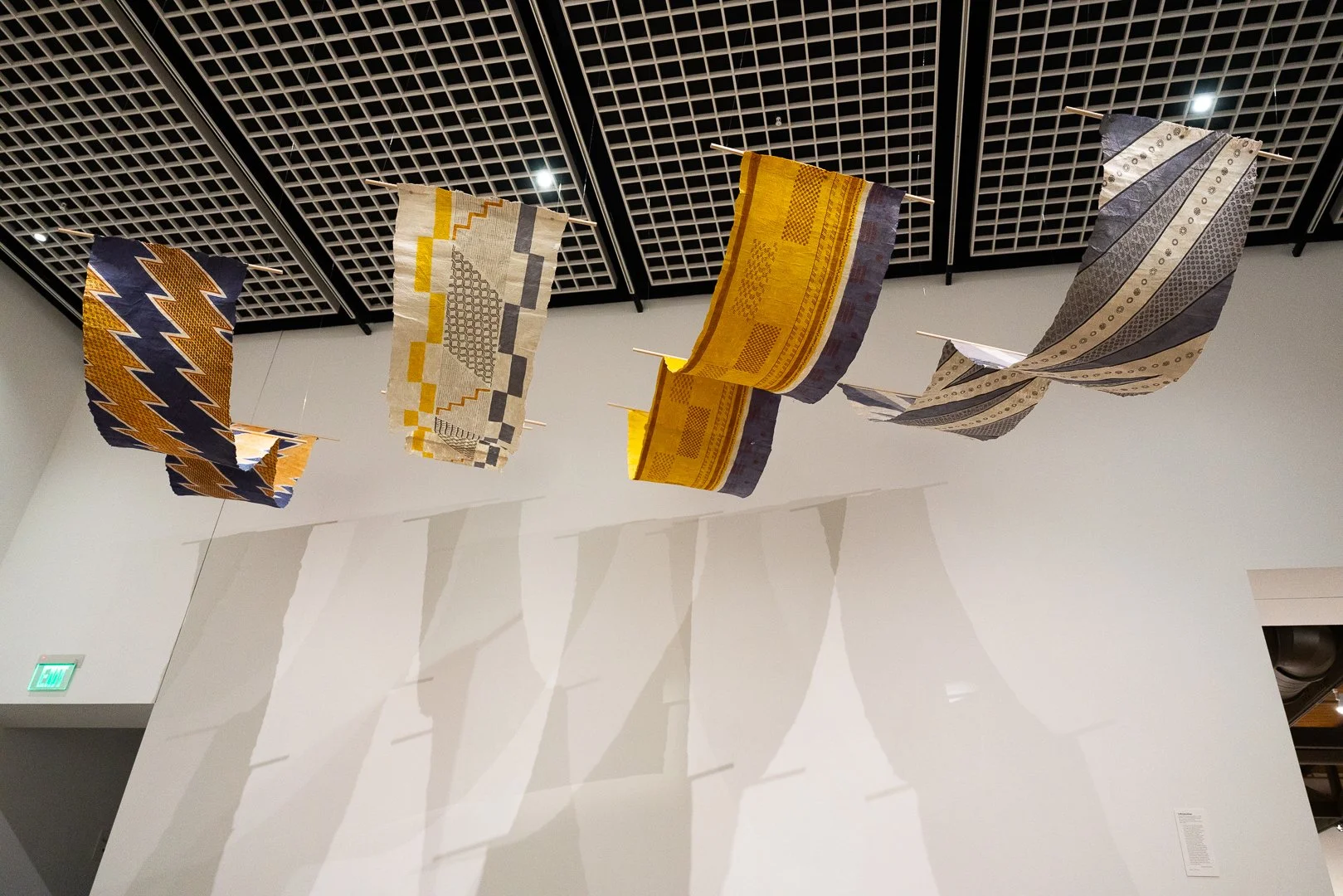
Ka ʻŌhū Loa O Ke Kai Uli (A Great Swell From The Deep Ocean) [installation view]. Plant dyes and earth pigments on kapa. Each 24 inches W x 144 inches L. 2022.
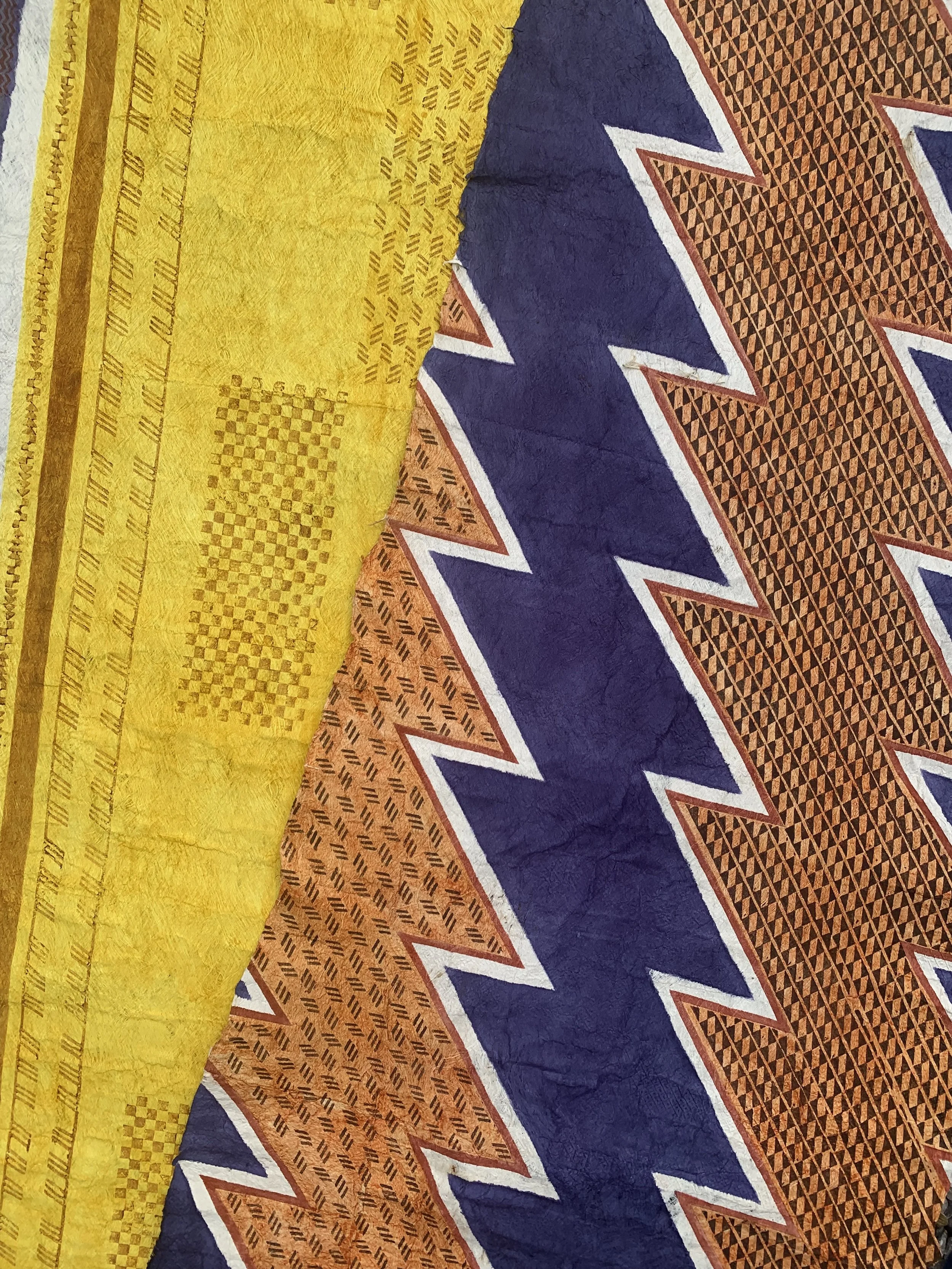
Ka ʻŌhū Loa O Ke Kai Uli (detail)
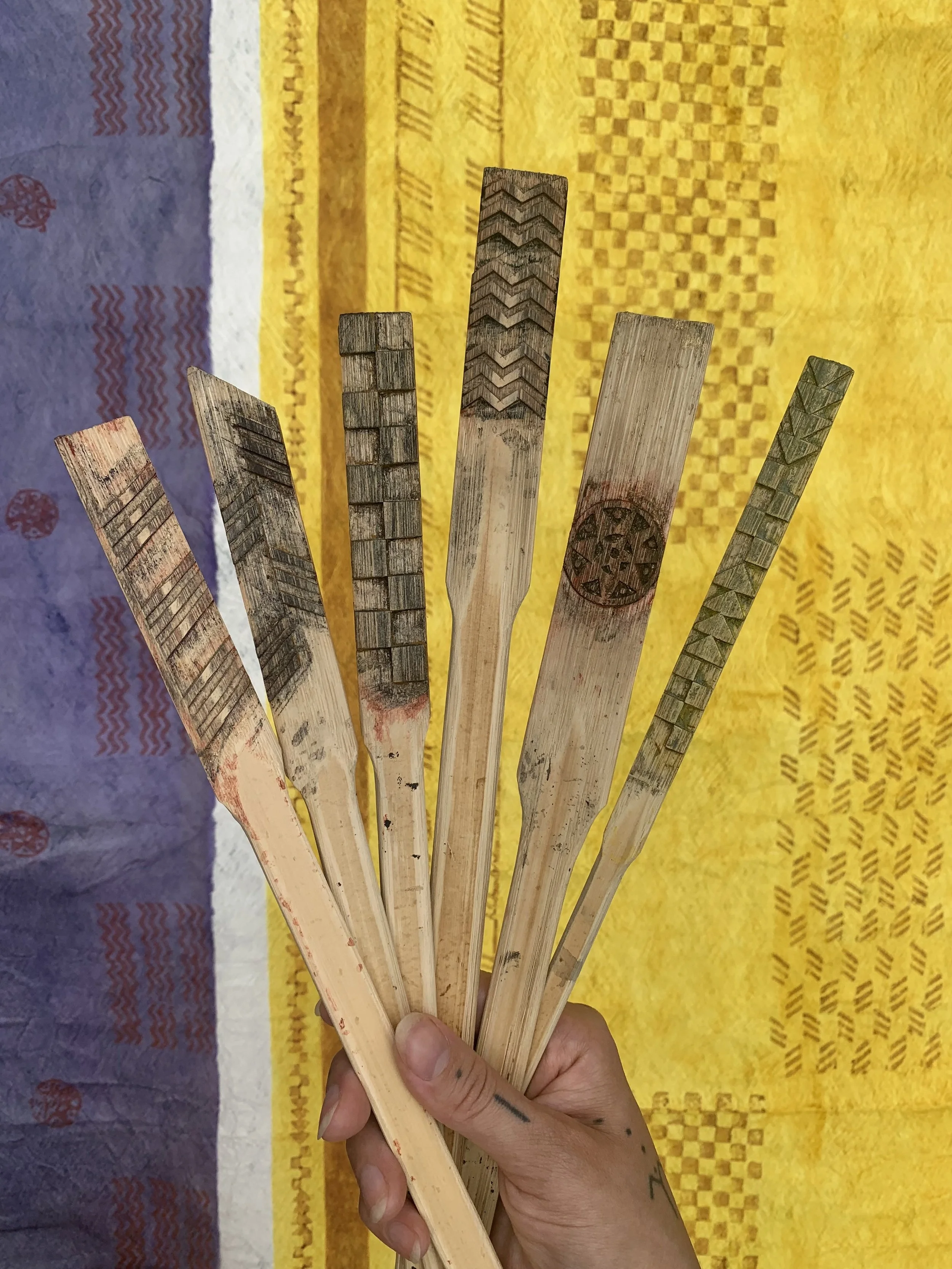
An assortment of ʻohe kāpala stamping tools used to make Ka ʻŌhū Loa O Ke Kai Uli
Ka Muliwai, Ke Ola (The Estuary, The Life), 2022
Ka Muliwai, Ke Ola (The Estuary, The Life) [installation view]. Acrylic ink, thread, gouache, metal leaf, Tyvek. Approx. 10 feet H x 30 feet W. 2022. Commissioned by Meta Open Arts.
Ka Muliwai, Ke Ola (The Estuary, The Lifeforce) is a mixed-media wall-mounted installation inspired by the abundance of waters — through the land and into the oceans — that flow in and around the Puget Sound region. In Native Hawaiian culture, plentiful water is equated to wealth, and its preservation is paramount in daily life. Using colorful traditional patterns and motifs typically seen on Hawaiian kapa, or bark cloth, the piece symbolizes the water’s journey from the mountains to the sea, representing dense forests, flowing streams, schools of fish, sea urchins, and more. As every being owes its life to the health of our waters, it is critical we recognize our role within this larger ecosystem.
Ka Muliwai, Ke Ola (The Estuary, The Life) [detail]
E Hoʻāla Ka Lupe (To Awaken the Kite), 2023
Funded by a Native Arts and Cultures Foundation LIFT Grant, this project sought to recreate traditional Native Hawaiian barkcloth kites using only natural materials gathered by the artist. Compiling archival, personal, and communal research, these kites celebrate the lesser-known custom of Hawaiian kite-flying as a tool for fishing, weather reading, divination, and pastime for those of high rank.
Lupe Huinahā (Four-Sided Kite). Red ochre pigment, hibiscus cordage and branches, bamboo, kapa (barkcloth). 21 inches H x 19.5 inches W.
Lupe Huinahā II (Four-Sided Kite). Earth pigments, hibiscus branches and cordage, kapa (barkcloth). 17 inches H X 17 inches W.
Lupe Hōkū (Star Kite). Earth pigments, hibiscus cordage, bamboo, shell, kapa (barkcloth). 16.5 inches H X 16.5 inches W.
Kaʻena’s Kite. Earth pigments, hibiscus cordage, bamboo, shell, kapa (barkcloth). 25 inches H X 25 inches W.
Lupe Hīhīmanu (Manta Ray Kite). Earth pigments, hibiscus cordage, bamboo, kapa (barkcloth). Approx. 33 inches H X 32 inches W.
Wearables, 2019-2024
Since the Beginning and End of Time (installation view). Indigo-dyed kapa, hand-embroidery, shell buttons, bells. Approx. 44 inches H x 50 inches W. 2024.
An ongoing series of hand-stitched wearable cloaks made using Hawaiian barkcloth and Japanese kimono silk from the artist’s family. Each cloak is modeled after the shape of traditional Native Hawaiian ʻahuʻula (feathered capes), and tell a unique story about the artist’s personal identity — relating to community, family lineage, and cultural preservation. The dense adornment, patchworking of different fabrics, and hand-embroidery become a meditative way of paying homage to one’s heritage.
Since the Beginning and End of Time (detail)
ʻAʻahu Hoʻokahuli Aupuni (Cloak of the Revolution). Hand-embroidery and shells on kapa, kimono silk, bridesmaids’ dress fabric. 2020.
Ancestor Blanket (installation view). Gifted beads, shells, and fibers on vintage Japanese silk, burlap, cotton, and kapa. 2019.
Ancestor Blanket (detail)
ʻAʻahu Hoʻokahuli Aupuni (Cloak of the Revolution) [detail]
Ancestor Blanket (detail)
Ancestor Blanket (detail)